The Next Chapter Of Music Technology
Discover how QIX collaborates with leading technology innovators to transform entertainment experiences through seamless integration and shared expertise.
Despite decades of innovation in loudspeakers, amplifiers, DSPs, and production software, most live music experiences remain fundamentally unchanged. The vast majority of clubs, festivals, and concert venues still reproduce music using front-focused stereo systems designed primarily for loudness rather than immersion. While sound pressure levels have increased, the audience experience remains largely two-dimensional. Ultra-low-frequency reproduction also remains limited, with many systems prioritizing output over depth, realism, and physical immersion.
Why Current Immersive Formats Have Not Solved The Problem
Immersive audio technologies have achieved significant success in cinema, where audiences face a screen and content follows a predefined visual narrative. Music presents a different challenge. Most immersive music releases today are derived from existing stereo productions rather than being composed specifically for spatial reproduction. As a result, many productions remain fundamentally stereo experiences distributed across additional speakers rather than true three-dimensional musical compositions.
The Missing Workflow
The industry currently lacks widely adopted methods for composing, performing, and distributing immersive music. There are no established standards for how DJs should interact with immersive content, how artists should compose for spatial environments, or how immersive productions should be exchanged between venues and playback systems. Likewise, there is no common framework for integrating stereo music, stems, samples, and live performance elements into immersive audience experiences.
The Challenge Of Large-Scale Immersion
Creating convincing three-dimensional sound in large venues introduces unique physical challenges. Unlike headphones or small rooms, large clubs, theaters, and festival environments must address propagation delays, audience movement, multiple listening positions, and the timing accuracy required for stable spatial perception. These challenges require new approaches to system design, content creation, synchronization, and performance workflows.
Building Open Standards Together
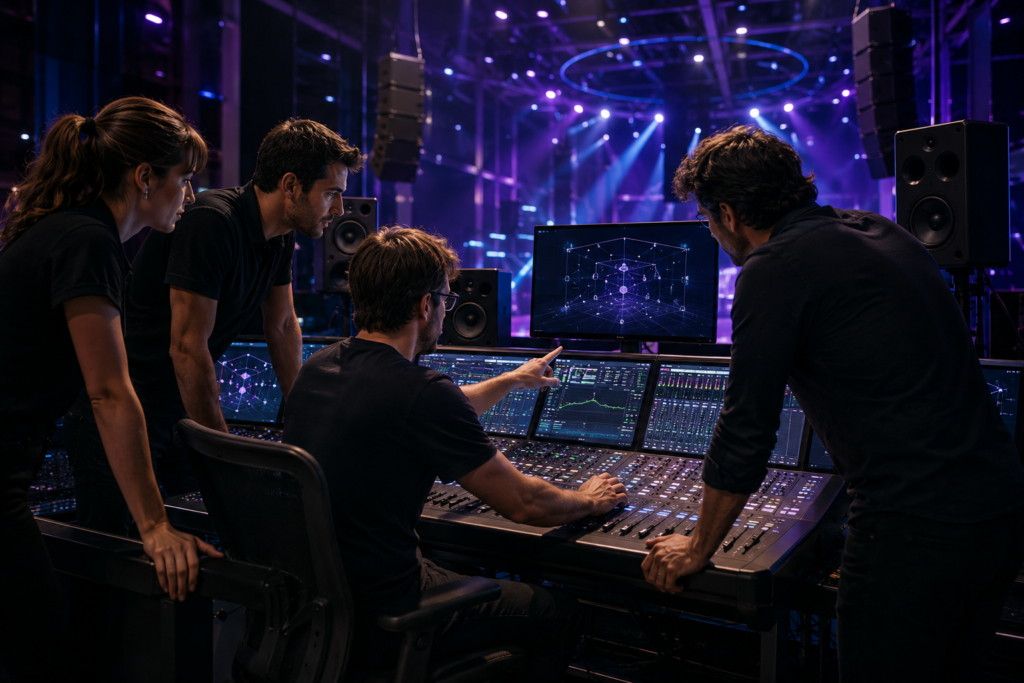
QIX Theater of Sound is being developed as a real-world experimentation platform where manufacturers, software developers, artists, engineers, researchers, and venue operators can collaborate to define best practices for the future of immersive entertainment. Our goal is to help establish open standards, interoperable workflows, and practical solutions that enable the industry to create, share, distribute, and perform immersive music content across different platforms and venues.
We believe the future requires open audio formats, new production methodologies, immersive DJ workflows, stem-based performance systems, and collaborative technology development. These tools will allow artists to move beyond stereo and unlock entirely new forms of musical expression.
Join The Initiative
QIX invites technology companies, audio manufacturers, software developers, universities, artists, and industry innovators to participate in this exploration. Together, we can develop the tools, standards, workflows, and technologies that will shape the next generation of music experiences.
Explore Our Commitment to Advancing Entertainment Technology
Dive into how QIX partners drive innovation by integrating cutting-edge audio, lighting, video, and venue technologies to redefine live experiences for audiences and event operators alike.
Innovative Collaborations with Our Technology Partners
The entertainment industry has reached a point where incremental improvements are no longer enough. While audio systems have become louder and digital tools more powerful, the fundamental experience of live music remains largely unchanged. QIX believes the next breakthrough will come from rethinking how music is created, performed, distributed, and experienced.
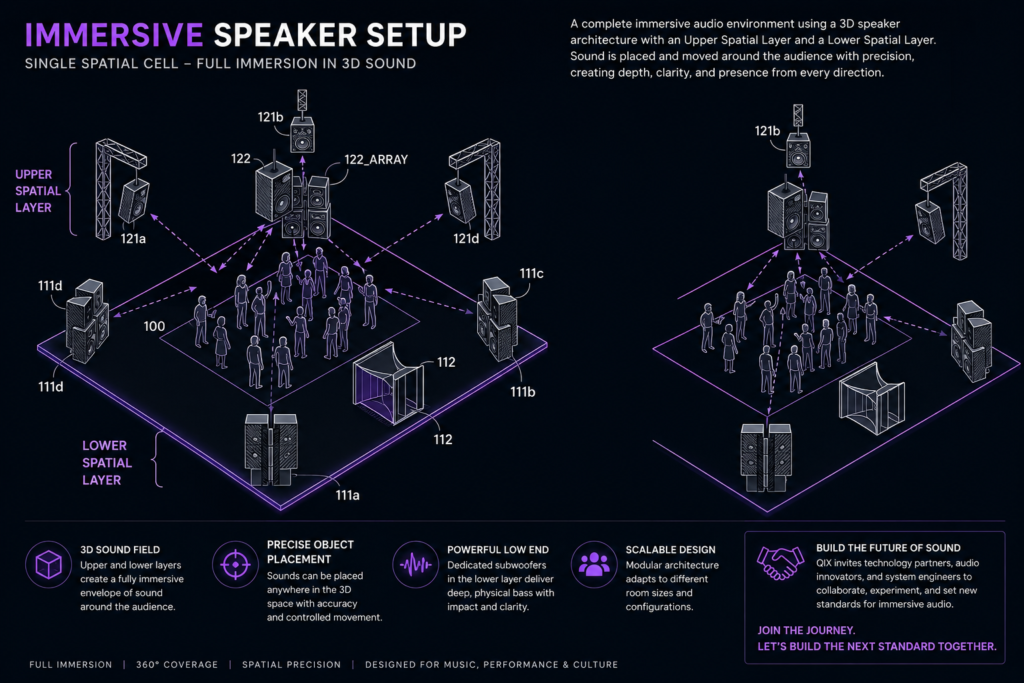
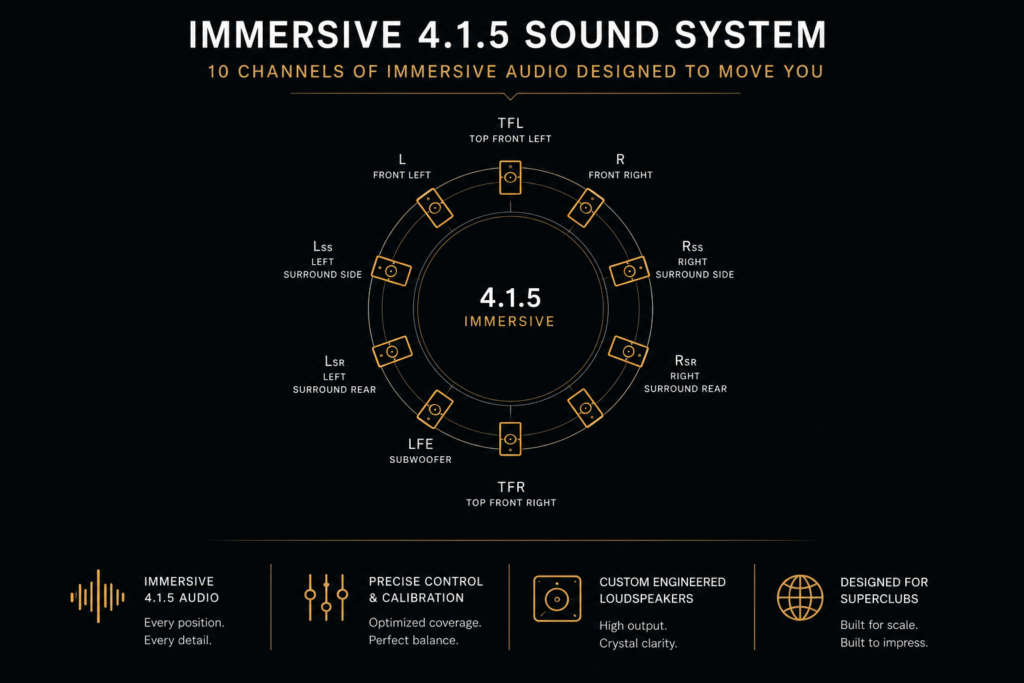
QIX Theater of Sound is being developed as a real-world innovation platform where technology companies, manufacturers, software developers, artists, and researchers can experiment with new ideas in front of live audiences. Together, we can explore immersive audio, next-generation bass reproduction, spatial music composition, interactive performance systems, AI-assisted production tools, and new methods of audience engagement.
Multi-Channel DJ Performance
Beyond Stereo Mixing
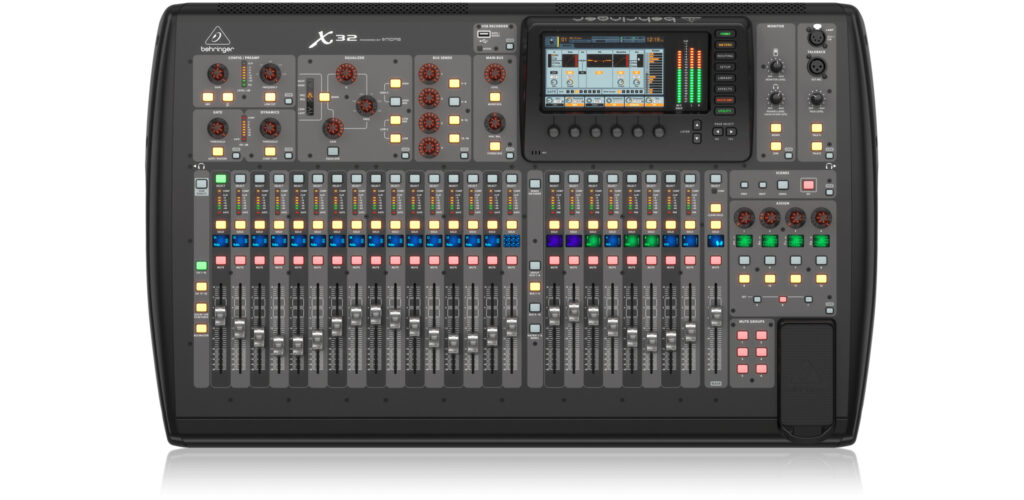
Modern DJs still perform primarily with stereo tracks, despite the availability of multi-channel sound systems. QIX is exploring new workflows that allow DJs to inject samples, stems, effects, vocals, and musical elements into a three-dimensional sound environment. The objective is to transform DJ performance from simple track playback into a dynamic spatial composition where sound can move, evolve, and interact with audiences throughout the venue.
Immersive Sound Architecture
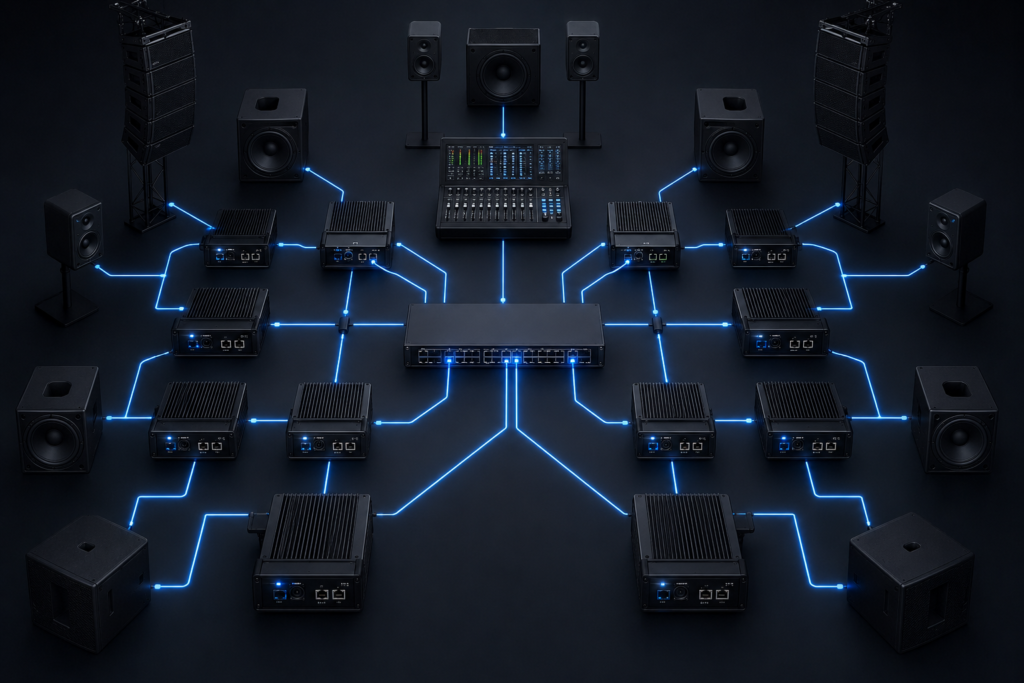
Network-Addressable Distributed Digital Power Amplification System
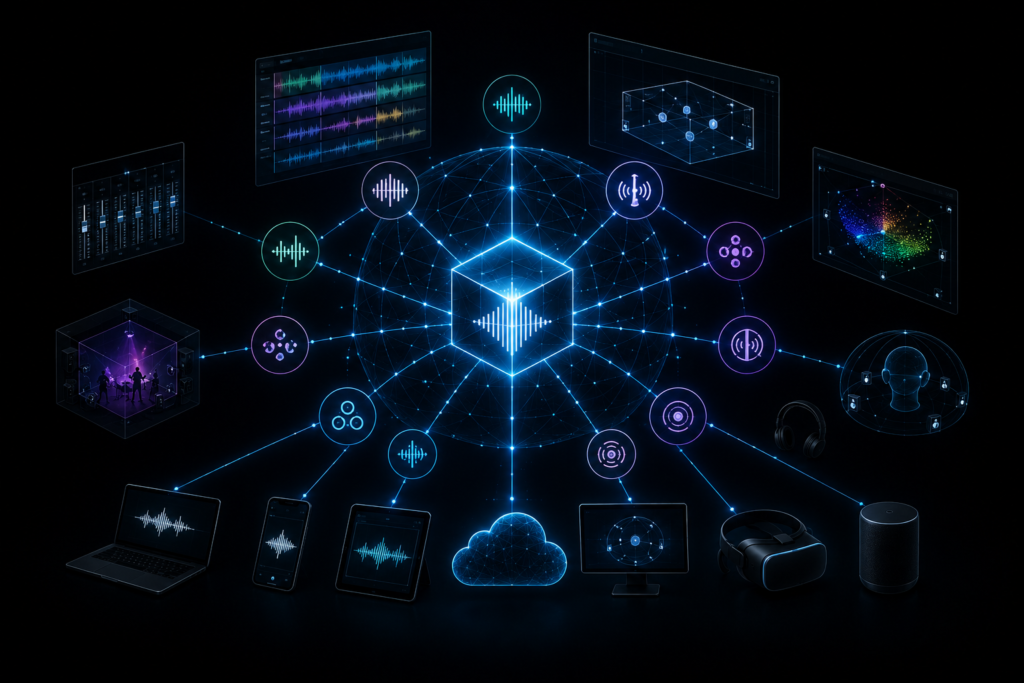
Immersive sound should not require complex and expensive infrastructure. QIX is investigating modular event sound architectures based on Audio-over-IP technologies that simplify deployment, reduce cabling requirements, and allow flexible expansion. By combining networked audio, distributed processing, and integrated power solutions, immersive sound systems can become practical for clubs, theaters, festivals, and temporary event environments.
Open Immersive Content Standards
Creating A Common Language For Spatial Audio
The entertainment industry lacks an open and widely adopted format for sharing immersive music content between artists, venues, and technology platforms. QIX supports the development of open standards for multi-channel audio, spatial metadata, stems, object-based sound, and immersive performance content. Our goal is to create interoperable formats that enable creators, venues, software developers, and manufacturers to exchange immersive experiences without being restricted to proprietary ecosystems.
Become Our Technology Partner Today
Our objective is not simply to deploy technology, but to help establish practical workflows, best practices, and open standards that benefit the entire industry. By collaborating across disciplines, partners gain access to real-world testing environments, valuable user feedback, content creation opportunities, and early participation in emerging entertainment technologies.
We believe the future of music experiences will be built through collaboration, experimentation, and shared innovation. QIX invites industry leaders and pioneers to help shape that future.